> For the complete documentation index, see [llms.txt](https://etherfi.gitbook.io/etherfi/llms.txt). Markdown versions of documentation pages are available by appending `.md` to page URLs; this page is available as [Markdown](https://etherfi.gitbook.io/etherfi/archive/solo-stakers/operation-solo-staker/obol-dvt-explained/dappnode-setup/obol-dvt-package/mainnet.md).
# Mainnet
### Install the Obol Mainnet package
Go to Dappnodes Github and find the newest [Obol package release](https://github.com/dappnode/DAppNodePackage-obol/releases)
Click on "release details" to find the IPFS hash of the package.
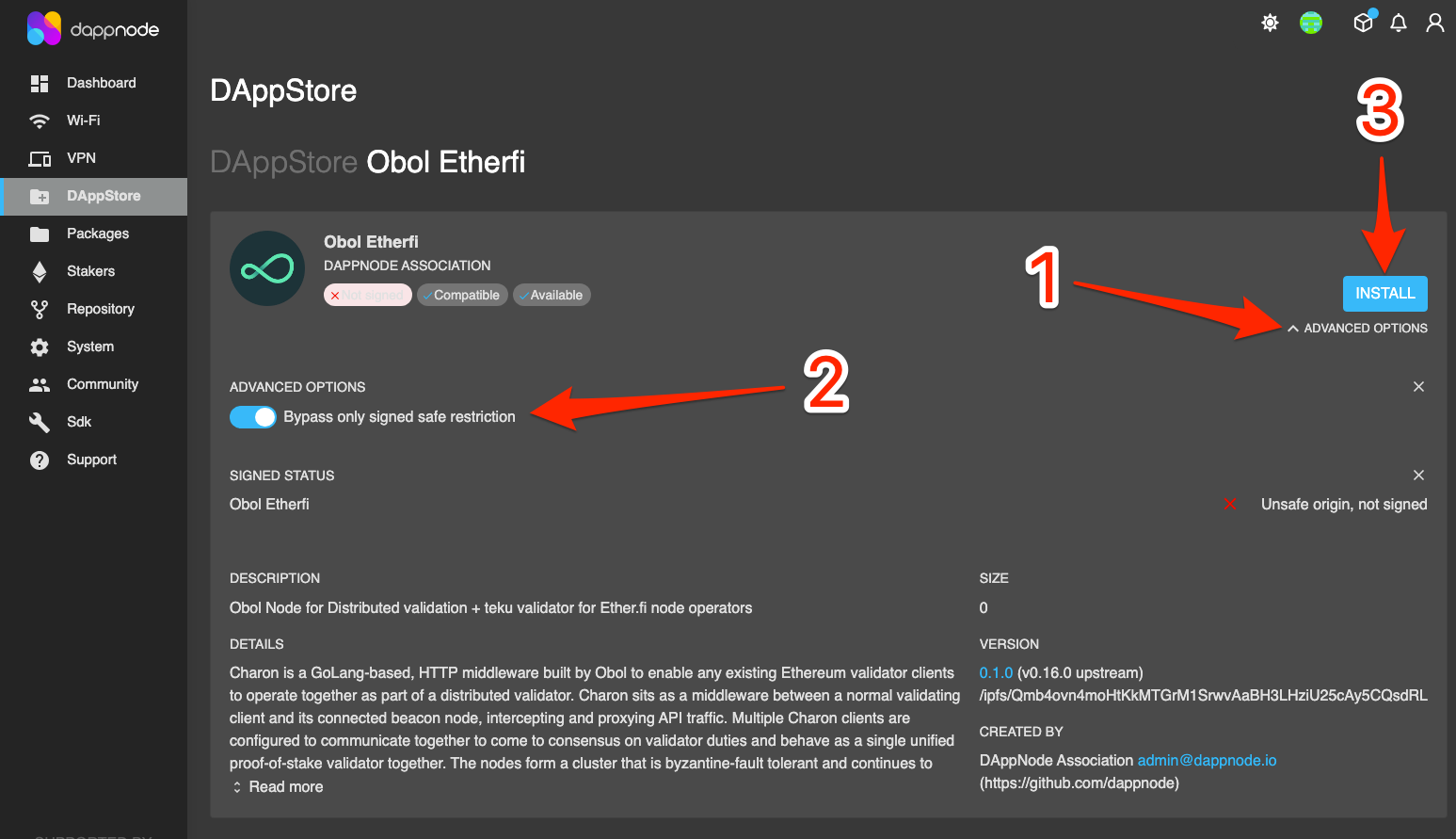
Navigate to the `DAppStore` page and enter the IPFS hash, then click `Search`.
Under `ADVANCED OPTIONS` make sure the toggle for `Bypass only signed safe restriction` is on so that the package can be installed.
Skip all the questions during installation without filling out any fields.
After installation is finished, navigate to the Obol Package and click on the tab BACKUP.
Click "Backup Now", which will download a file with a `.tar.xz` ending. Expand the file and you should see the following contents.
Delete all files from the `charon1` directory. Now expand the keyshare file you received from ether.fi and put all the contents into the `charon1` directory.
Open the `cluster-lock.json` file and find the `operators` array and find your operator entry. The file you received will have the number of your node in the cluster. Keep in mind that the first node is node0, so node3 would be the fourth operator in the array for example.
Next, create a file called `enr` (just `enr` without a file ending).
Open the `enr` file in a text editor and paste your enr text from the operator array in the `cluster-lock.json`. Save the file and exit.
Your contents should now look like the following:
Only `charon1` has changed. The other folders have to stay unchanged.
Now you have to pack all the charon folders back to a `.tar.xz` file. This is different on all OSs but on Linux and macOS, you can do the following in the Terminal:
```
cd directory-with-charon-folders
tar -cvf obol-backup.tar ./
xz obol-backup.tar
```
On macOS you might need to install the xz package with Homebrew:
After those commands, you should see an `obol-backup.tar.xz`. You will need it in the next step.
Open the Dappnode interface again and go to packages. Make sure to start the package "Obol", as the containers should be stopped right now. You need to be fast with the next step, as otherwise the Obol package will exit again and you need to start it again before continuing.
Next, navigate to the Obol packages Backup tab.
Click "Restore" and select your `obol-backup.tar.xz` you created just before. Restore from this file.
This should be it. If you notice any errors during Restore, start the obol package again and click restore again. It takes a few tries sometimes to get it right.
You can now check your Logs now and tell ether.fi that you finished the process.
---
# Agent Instructions
This documentation is published with GitBook. GitBook is the documentation platform designed so that both humans and AI agents can read, navigate, and reason over technical content effectively. Learn more at gitbook.com.
## Querying This Documentation
If you need additional information that is not directly available in this page, you can query the documentation by asking a question.
Perform an HTTP GET request on the following URL with the `ask` and `goal` query parameters:
```
GET https://etherfi.gitbook.io/etherfi/archive/solo-stakers/operation-solo-staker/obol-dvt-explained/dappnode-setup/obol-dvt-package/mainnet.md?ask=&goal=
```
`ask` is the immediate question: it should be specific, self-contained, and written in natural language.
`goal` is what the user is ultimately trying to achieve, the reason they need the answer. Sharing it helps GitBook give you a better, more relevant answer. A goal is most helpful when it describes the outcome the user wants rather than restating the question. For example, with `ask=how do I create an API token`, a goal like `automate deployments from our CI pipeline` lets GitBook tailor the answer to that use case.
The response will contain a direct answer to the question and relevant excerpts and sources from the documentation.
Use this mechanism when the answer is not explicitly present in the current page, you need clarification or additional context, or you want to retrieve related documentation sections.